

How a vasectomy works
What happens during a no needle, no scalpel vasectomy, what recovery is like, and how well it works.
What a vasectomy does
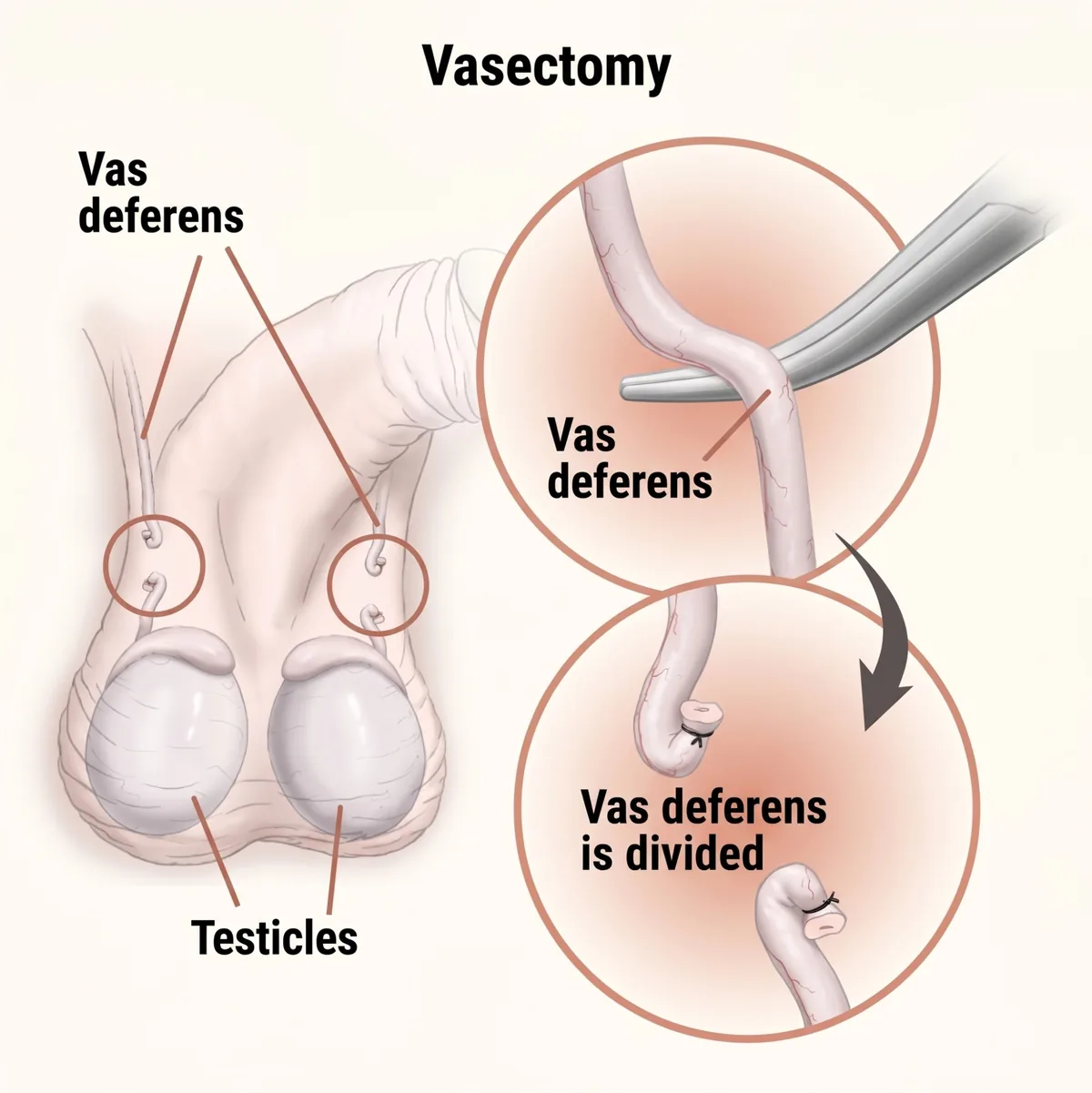
Sperm are made in the testicles and travel through two thin tubes, one on each side, called the vas deferens. A vasectomy blocks and separates each tube so sperm no longer reach your semen.
Sperm make up only a small part of semen, so most men notice no change in what they ejaculate. Vasectomy generally does not change testosterone, sex drive, erections, or ejaculation. It is meant to be permanent, and it does not protect against sexually transmitted infections.
Before the procedure
You start with a free consultation. Dr. Guendel goes over your health history, examines both sides, and answers your questions. If an office vasectomy is a good fit, you schedule it for a later visit, so you have time to decide.
You don’t need a partner’s permission or signature. We tell you how to prepare before your procedure day.
During the procedure
- Numbing. A needle-free jet injector uses pressure to deliver local anesthetic through the skin. A small injection is added only if needed. You stay awake.
- One small opening. Dr. Guendel makes a small opening in the skin instead of an incision with a scalpel.
- Sealing the tube. One vas deferens is gently brought to the opening and divided. The end that leads away from the testicle is sealed from the inside with heat.
- Keeping the ends apart. A thin layer of tissue is closed over the sealed end with a tiny clip, so the two ends stay separated. Nothing is removed.
- The other side. The second vas deferens is treated the same way through the same opening.
Most office vasectomies take 30 minutes or less. Afterward you get a gauze dressing and a supporter, and you rest for about 15 minutes. You may drive yourself home once a recovery check shows you’re ready.
Recovery
- Rest at home for 24 to 48 hours. Short, gentle walks are fine.
- Wear snug, supportive underwear, and use a wrapped cold pack for comfort.
- Desk work may be comfortable after one or two days. Heavy work may take longer.
- Avoid heavy lifting, hard exercise, and ejaculation for one week.
Mild soreness, some bruising, and slight swelling can occur and should gradually improve. You go home with a written pain-medicine plan, the warning signs to watch for, and how to reach us.
Testing and written clearance
A vasectomy does not work right away. Sperm can stay in the tubes for weeks to months.[4] Keep using other birth control until Dr. Guendel reviews your semen test and gives you written clearance.
We ask you to wait 12 weeks before your test. The AUA allows a sample as early as 8 weeks, but a longer wait gives a better chance of a no-sperm result.[1] We arrange a home test kit and pay for it, along with every repeat test Dr. Guendel orders.
The American Urological Association (AUA) accepts mail-in testing. A sample checked within two hours can pass with no sperm or up to 100,000 rare non-motile sperm per mL. A mailed sample is checked later, when sperm movement can’t be judged reliably, so it should show azoospermia, meaning no sperm detected.[1] We use the lab’s result, and the lab reports azoospermia when it finds fewer than 3,300 sperm per mL.
In a study of 400 men having cautery vasectomy, about 95% to 96% had no sperm or fewer than 100,000 sperm per mL by 12 weeks. By 24 weeks, that figure was 99%.[2] So needing another test doesn’t by itself mean the vasectomy failed.
How well it works
After clearance, the chance of pregnancy is about 1 in 2,000, according to the AUA.[1] That is very low, but not zero. Pregnancy can still happen after clearance.[1]
| Method | Rate | About |
|---|---|---|
| Vasectomy after written clearance | 0.05% | 1 in 2,000 |
| Implant | 0.1% | 1 in 1,000 |
| Vasectomy, all users, first year | 0.15% | 1 in 670 |
| Hormonal IUD | 0.1% to 0.4% | 1 in 1,000 to 1 in 250 |
| Tubal surgery | 0.5% | 1 in 200 |
| Copper IUD | 0.8% | 1 in 125 |
| Birth control shot | 4% | 1 in 25 |
| Pill, patch, or ring | 7% | 1 in 14 |
| Male condom | 13% | 1 in 8 |
The first row is the AUA’s risk after a passing test. It is not a yearly rate, so the comparison is approximate. All other rows are the CDC’s rates for the first year of typical use.[3] The 0.15% row covers vasectomy users in general, not only men with clearance. The CDC also publishes a chart of birth control methods; it dates from 2016, so some of its numbers differ.
The procedure itself rarely fails. The AUA reports that a repeat vasectomy is needed in 1% of cases or fewer when a low-failure technique is used.[1] A 2025 study of 2,239 vasectomies using the technique described above found that it failed to block the tube in 0.3%.[5]
These numbers come from published research, not from this clinic’s own patients. Our repeat-or-refund promise explains what happens if a vasectomy is confirmed unsuccessful.
Risks
Serious problems are uncommon, but every procedure has risks. Dr. Guendel reviews them with you at the consultation.
- Pain, bruising, swelling, or fainting.
- A blood collection (hematoma) or infection, in about 1% to 2% of vasectomies.[1]
- Long-lasting scrotal pain that affects quality of life, in about 1% to 2%.[1] Treatment may not fully resolve it.
- A reaction to the numbing medicine.
- A tender lump where sperm leaks near the procedure site.
- Failure of the procedure, or the tubes reconnecting.
Reversal is sometimes possible, but it is a bigger procedure and cannot guarantee a future pregnancy.
Sources
- Schlegel PN, et al. Vasectomy: AUA Guideline (2026). American Urological Association. Summarized in American Family Physician, 2026.
- Barone MA, et al. Effectiveness of vasectomy using cautery. BMC Urology, 2004.
- CDC. Contraception and birth control methods, 2024.
- CDC. Permanent contraception, 2024.
- Diabaté S, et al. Occlusive effectiveness of open-ended no-scalpel vasectomy with mucosal cautery and fascial interposition. Asian Journal of Andrology, 2025.
More reading: JAMA Patient Page, Urology Care Foundation, and Cleveland Clinic.
Clinical information by Alexander Guendel, MD, based on the clinic’s consent and aftercare instructions dated October 21, 2026, and the sources above. Updated November 4, 2026.